
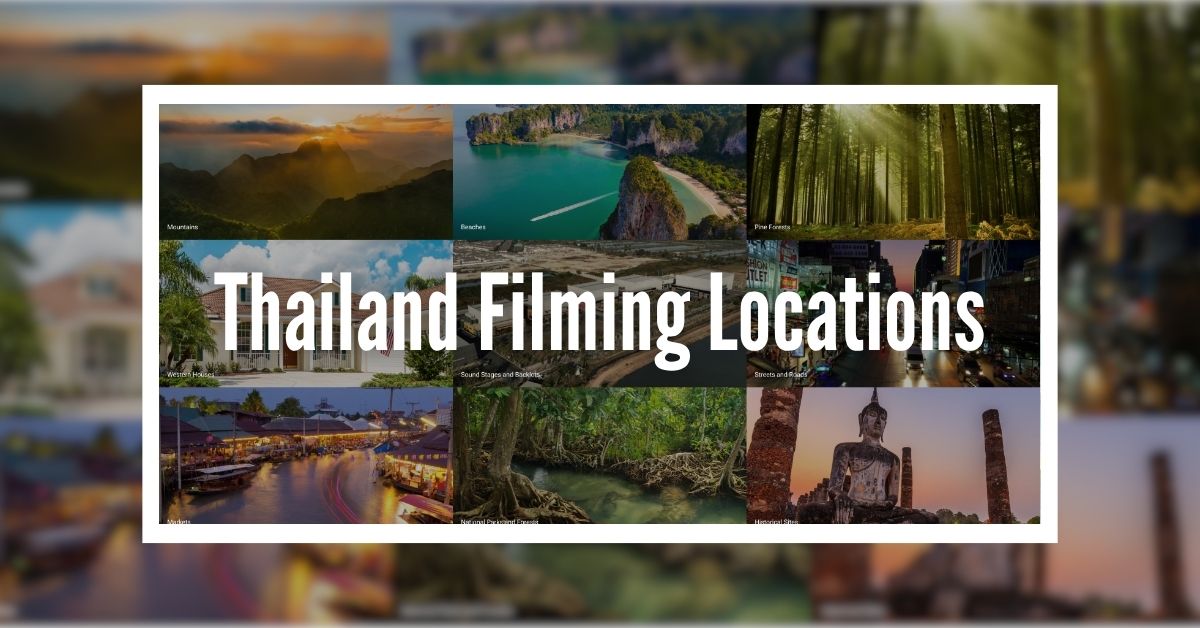
Thailand is currently on screen more than almost anywhere else in Southeast Asia: The White Lotus Season 3, Alien: Earth, The Creator, and Jurassic World: Rebirth all shot here, on top of a steady stream of K-dramas and global campaigns. Mbrella Films is a Bangkok-based production company, and we put together this guide from our own location library, the same one our producers use to build treatments, shot lists, and budgets for agencies, streaming platforms, and studios shooting in Thailand.
Below, we cover 25 of the country’s most film-ready locations, organized by region, with what each one actually offers a production, not just where a famous scene was shot, followed by what producers need to know before locking a shoot date: permits, incentives, and seasonal windows.
Why productions keep choosing Thailand?
Thailand offers a rare combination for producers: a wide range of visual registers within a short drive of each other, a deep bilingual crew base, an established film-incentive program, and a permit system that decades of foreign productions have already stress-tested. Recent productions shot here include The White Lotus Season 3, The Beach, The Hangover Part II, The Creator, Extraction, Alien: Earth, American Gangster, and Only God Forgives.
Bangkok delivers dense urban texture and a working river. The central plains hold three former kingdoms and the country’s largest accessible national park. The north climbs into highland valleys and Lanna-period temple architecture. The northeast opens into Khmer-era temple complexes. The south breaks into limestone karsts and island coastline on two seaboards. Most of it sits within a single travel day of Bangkok.
Bangkok and the river corridor
1. Khao San Road

Khao San Road’s density is what sells it to producers: three dense blocks of stacked signage, stalls, and low-rise shopfronts give a chaotic, high-energy street look that reads as generic Southeast Asian urban backdrop rather than specifically Bangkok. That range is why it has carried both a backpacker-culture drama and a straight comedy without needing to change dressing, including The Beach (2000) and The Hangover Part II (2011).
Production note: high foot traffic and dense signage make this a strong practical-light location after dark. Road closures for larger units need to be scheduled with the district office well ahead of the shoot day.
2. Mandarin Oriental Hotel

The Mandarin Oriental’s colonial-era wings and teak riverside pavilions give producers old-world five-star luxury without building a set: paneled interiors, manicured gardens, and a private river frontage read as timeless hospitality rather than anything specifically Thai. That flexibility is why the property has carried a Bond-era spy thriller and a contemporary K-drama with equal ease, from The Man with the Golden Gun (1974) to Love in the Big City (2024).
3. The Temple of Dawn (Wat Arun)

Wat Arun’s steep, tiered prang gives producers vertical blocking that’s hard to find elsewhere: shot wide, it reads as a graphic backdrop for slow romantic coverage; shot tighter, its stacked terraces double as elevated ground for choreographed action, which is exactly how Mortal Kombat (2021) staged its fight sequence on the steps. Its riverside position also lets land and water units work the same setup, as King the Land (2023) did for its pagoda scene.
Production note: as an active religious site, Wat Arun requires coordination with the temple office alongside standard TFO clearance. Talent wardrobe and blocking need pre-approval.
4. Patpong

Patpong’s neon-lit footprint has barely changed in fifty years, which is exactly why productions keep returning to it: it reads convincingly as Southeast Asian nightlife across multiple decades without a production needing to dress the era. It has carried a Vietnam-War-era backdrop in The Deer Hunter (1978), Cold War-era intrigue in The Killing Fields (1984) and Miss Saigon (1989), and contemporary spy thriller atmosphere in Tomorrow Never Dies (1997).
5. Yaowarat Road (Chinatown)

Yaowarat’s dense signage, narrow shopfronts, and vertical neon give it a look that reads as generic pan-Asian Chinatown rather than specifically Thai, which is why Street Fighter (1994) used it for a fictional setting rather than a Thailand-specific one, and Only God Forgives (2013) used it for stylized crime-thriller atmosphere. The narrow alleys also give strong practical cover for foot chases and close-quarters blocking. Most recently, LISA’s single ‘Rockstar’ Music Video was also shot here.
Production note: the street only fully animates after dark, so night-shoot logistics (power, crowd control, vehicle access) should be planned around the practical neon rather than added lighting.
6. Soi Cowboy

Soi Cowboy’s short, contained footprint is a practical advantage as much as a visual one: a single short street is easier to close, light, and control than a sprawling district, while still delivering the neon-bar look a production needs. That efficiency is part of why it carried The Hangover Part II (2011) and Bangkok Dangerous (2008).
7. ICONSIAM

ICONSIAM’s tiered glass-and-gold architecture and river frontage give producers a contemporary luxury-retail look that doesn’t read as any one country, useful for brand and lifestyle content as much as narrative drama. That flexibility is how it carried a romance sequence in King the Land (2023), shot in front of its waterfall feature.
8. Maeklong Railway Market
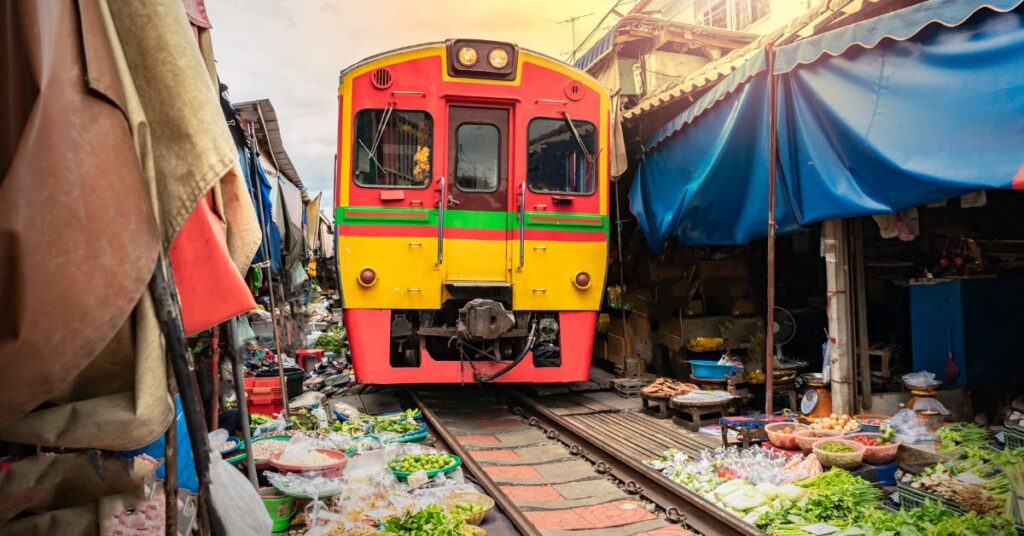
Maeklong earns its place on a shortlist for a different reason than most locations in this guide: it’s a single, unrepeatable hero shot rather than a flexible backdrop. A working commuter line running directly through an active market gives productions an instantly legible, culturally specific insert in one efficient setup, without multi-day dressing or a large unit footprint.
Production note: shot planning has to align with the published rail timetable, and a safety officer from the State Railway of Thailand sits with the unit for the duration of the shoot. Best suited to smaller crews.
Central Thailand
9. Wat Phra Si Sanphet (Ayutthaya)

Ayutthaya’s brick stupas and open horizon give producers a period register that reads as an ancient Southeast Asian kingdom rather than a historically specific site, which is what let Mortal Kombat: Annihilation (1997) use it as a fictional mystical setting rather than a real one. Its proximity to Bangkok, under two hours, keeps that period look inside a single travel day, and it has also anchored the more historically grounded The Last Executioner (2014) and The Legend of Suriyothai (2001).
Production note: drone work at Ayutthaya follows separate regulation from ground filming, and ground units coordinate with the Fine Arts Department through the TFO. Light peaks October through February.
10. River Kwai Bridge (Kanchanaburi)

Kanchanaburi’s mix of a functioning historic bridge, river, and dense jungle gives producers a working period set piece rather than a static monument. That combination is why the province has stood in for Southeast Asian war and jungle settings across multiple productions, including The Railway Man (2013), Beyond Borders (2003), Operation Dumbo Drop (1995), and Casualties of War (1989).
11. Erawan Falls (Kanchanaburi)
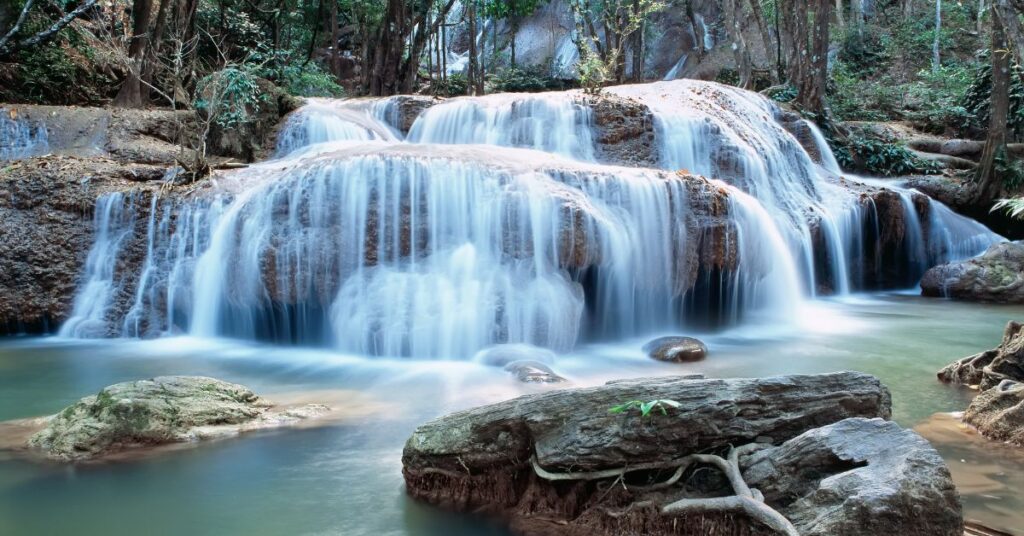
Erawan’s seven separate tiers mean a single location scout covers multiple distinct looks, from wide jungle-canopy shots at the base to intimate pool coverage higher up, without relocating the unit. That range makes it a strong pick for period, road-movie, and jungle-adventure work that needs more than one visual beat from a single site, all within a single travel day of Bangkok’s studios and crew base.
Production note: the Erawan and Sai Yok national park offices issue permits through the TFO. The upper tiers require a hike with hand-carried gear, so equipment lists should be built accordingly.
12. Khao Yai National Park (Nakhon Ratchasima)

Khao Yai packs open savannah, dense rainforest, and multi-tier waterfalls inside one park boundary, so producers scouting jungle or wildlife content don’t need to string together several far-flung locations to cover the range. Combined with a three-hour drive from Bangkok, it’s the default choice for jungle and wildlife work on a tight schedule, which is why it has carried an action comedy in The Hangover Part II (2011) and a domestic drama in A Little Thing Called Love (2010) alike.
Production note: the park enforces dawn-to-dusk gate hours and a pre-approved unit-size limit. Wildlife work runs through wrangler partners, and shooting resident wild populations is observational only.
Northern Thailand
13. Wat Phra Putthabat Tak Pha Temple (Chiang Mai)

This temple’s mountainside staircase and shrine give producers an elevated, isolated spiritual setting distinct from Bangkok’s riverside temples, useful for a Southeast Asian mountain-monastery register that doesn’t read as overtly Thai. That’s roughly how Rambo III (1988) used it, in a story set well outside Thailand, alongside the more period-accurate The King and I (1956).
14. Chinatown (Chiang Mai)

Chiang Mai’s Chinatown gives producers a second, quieter Chinatown register distinct from Yaowarat’s density, useful when a production needs the same cultural texture without repeating Bangkok’s look, or when the schedule already has the unit based in the north. American Gangster (2007) and Ong-Bak: Muay Thai Warrior (2003) both used it for that reason.
15. InterContinental Chiang Mai The Mae Ping

This hotel’s central position near Chiang Mai’s Night Bazaar makes it useful as both a shooting location and a unit base in the same footprint, cutting logistics for productions working across the city. No Escape (2015) used it to stand in for a hotel in an unnamed Southeast Asian country during political unrest, a good example of how readily the property doubles for a setting that isn’t specifically Thailand.
16. Wat Rong Khun, the White Temple (Chiang Rai)
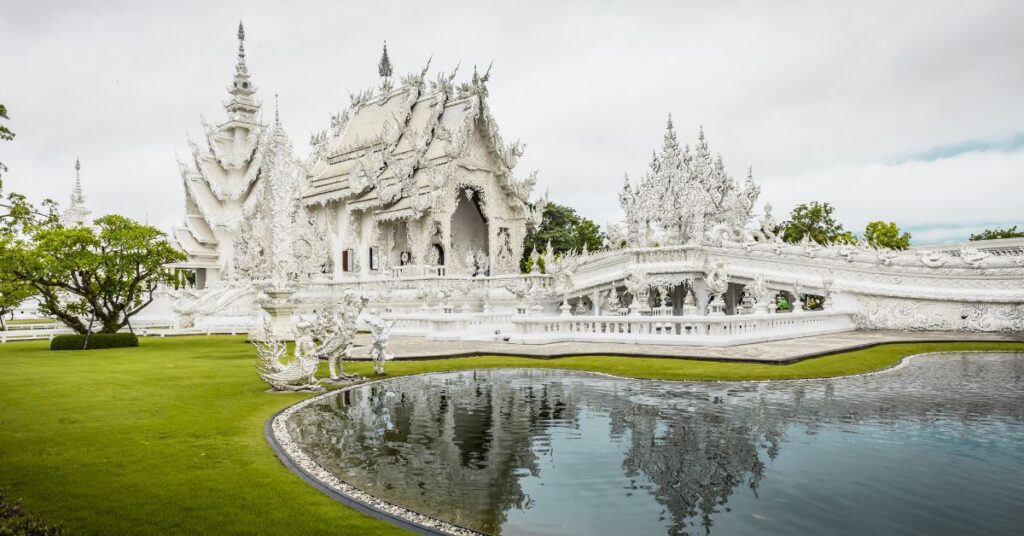
Wat Rong Khun’s near-monochrome, all-white architecture makes it one of the most stylistically flexible temple sites in the country: it reads as graphic and surreal rather than literal, which suits high-concept, fantasy, or heavily graded work better than a naturalistic temple shoot would. Its neighbor, the black-toned Baan Dam, gives the same production a tonal opposite within a short drive.
Production note: Wat Rong Khun is a working artist site and closes to visitors during shoots, which limits available windows. Talent wardrobe and direction require pre-clearance with the site’s foundation.
17. Sukhothai Historical Park
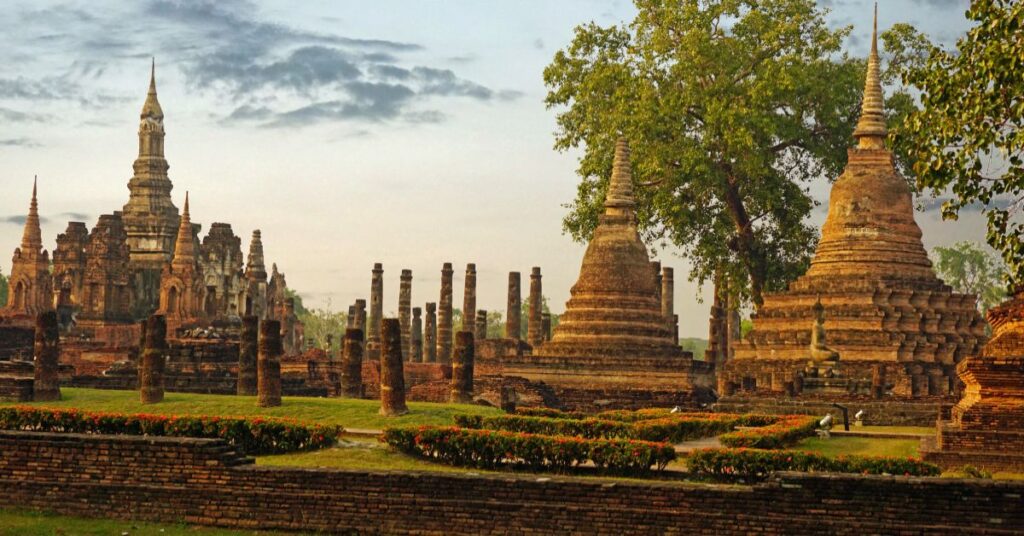
Sukhothai’s more dispersed, less-restored ruins give producers a period look that reads as a distinct, older civilization rather than a repeat of Ayutthaya’s more recognizable brick silhouette, useful for productions that need an ancient-kingdom setting without the visual signature audiences already associate with Ayutthaya.
Production note: the park splits into three zones (central, north, west). A scout should confirm which zone fits the brief before the recce is scheduled.
Northeastern Thailand (Isaan)
18. Phanom Rung
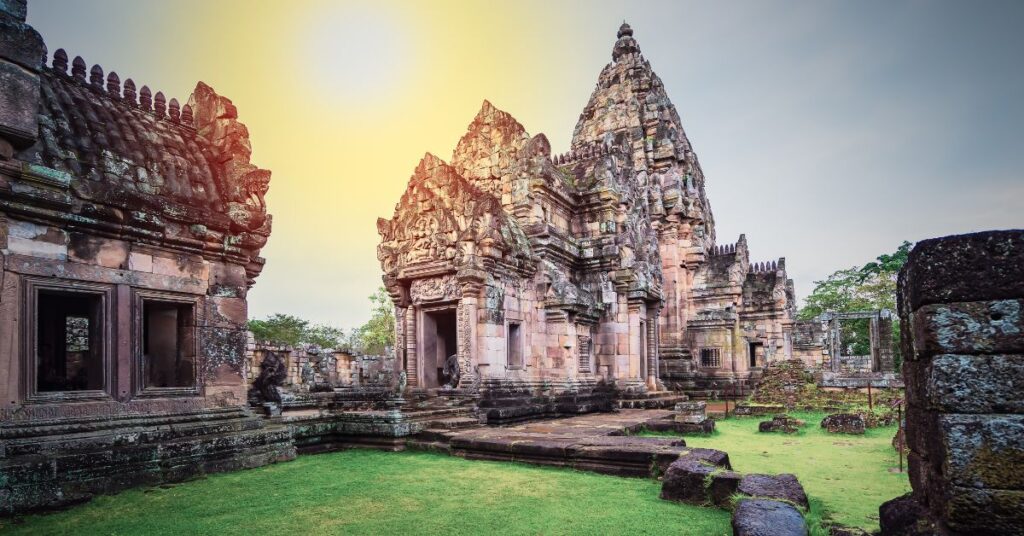
Phanom Rung’s Khmer sandstone architecture gives producers Angkor-scale civilizational grandeur without the logistics of shooting in Cambodia, useful for any production that needs a lost-civilization register and can work within Thailand’s permit and incentive framework instead of a separate country’s.
Production note: the Fine Arts Department staffs the site, and shoots are scheduled outside peak visiting hours. The drive from Bangkok runs five to six hours one way, so this location typically anchors its own unit day rather than combining with a Bangkok-based schedule.
Southern islands and the Andaman coast
19. Four Seasons Resort Koh Samui (Koh Samui)

Credit: Four Seasons Resort Koh Samui
Contemporary villa architecture and understated luxury finishes give this property a look that reads as high-end tropical resort rather than anywhere specifically Thai, exactly the register HBO’s The White Lotus Season 3 needed for its pools, common areas, and the Ratliff family villa. Additional filming took place at Anantara Lawana Koh Samui and Anantara Bophut Koh Samui, and the production drew on Thailand’s film incentive to offset costs, the same framework covered below.
20. James Bond Island (Phuket)

The island’s vertical limestone spire rising out of flat water gives producers an instantly graphic, almost fantastical silhouette that reads as exotic with no context required. That’s why it has carried both spy-thriller spectacle in The Man with the Golden Gun (1974) and backpacker-paradise imagery in The Beach (2000) with equally little dressing needed.
21. Phang Nga Bay (Phuket)

Phang Nga’s karst islets and lagoons read as generic tropical, or even alien, terrain rather than specifically Thai, which is why the same geography has carried a fantastical planetary backdrop in Star Wars: Episode III, Revenge of the Sith (2005) and grounded action spectacle in F9: The Fast Saga (2021) without changing locations.
Production note: the bay sits inside a marine national park, which constrains drone and aerial work but rewards it visually where cleared. Phuket serves as the practical unit base, with daily shuttle by speedboat or longtail.
22. Naiyang Beach (Phuket)

Naiyang stays quieter and less developed than Phuket’s more built-up beaches, giving producers a cleaner frame with less crowd and signage management to work around, useful for intimate or romantic coverage that needs an uncluttered beach look, which is how Bridget Jones: The Edge of Reason (2004) used it.
23. Old Phuket Town

Old Phuket Town’s Sino-Portuguese shophouses share an architectural lineage with other historic Southeast Asian port towns, Malacca and Penang among them, so producers can use it to stand in for that broader colonial-era trading-port look rather than Phuket specifically. The Beach (2000) shot at the On On Hotel, now The Onion Hostel, for exactly that period texture.
24. Maya Bay (Phuket)

Maya Bay’s enclosed cliff walls give producers a naturally contained set: the surrounding limestone blocks sightlines and sound from outside the cove, part of why it works so well as an isolated-paradise setting, the register The Beach (2000) built its entire third act around.
25. Krabi

Krabi’s combination of limestone cliffs, beach, and dense jungle inside one province is what makes it Thailand’s most flexible coastal location: producers can cover a beach register, a cliff-and-lagoon register, and a jungle register without moving far between them. That range is exactly why Jurassic World: Rebirth (2025) chose Khao Phanom Bencha National Park and Huai To Waterfall to stand in for a fictional prehistoric island, on top of Krabi’s longer track record in The Beach (2000), F9: The Fast Saga (2021), Star Wars: Episode III, Revenge of the Sith, The Hangover Part II (2011), Mortal Kombat (1995), and The Amazing Race.
Production note: boat-based units, swing-tide planning, and weather windows drive the shoot schedule here. The wet season (May to October) compresses available days, so build contingency into the calendar.
Locations permits, incentives, and seasons: What you need to know
Location Permits
Filming in Thailand as a foreign production is governed by the Film and Video Act B.E. 2551 (2008). Under the Act, any foreign filmmaker shooting a feature, series, commercial, documentary, or other audiovisual production in Thailand must hold a permit from the Thailand Film Office (TFO), under the Department of Tourism. Shooting without one is a legal violation, equipment can be seized on set, and there is a hefty fine.
A foreign production cannot apply for this permit directly. The Act requires every application to be filed by a Local Coordinator, a company or individual officially registered with the TFO, acting as the production’s legal representative with Thai authorities. For TV series and feature-length productions specifically, that Local Coordinator has to be a registered company, not an individual. Mbrella Films is a registered Local Coordinator with the Thailand Film Office. We file the application, hold the liaison relationship with the Film Board, and stay on-site with the TFO monitor officer during the shoot.
What goes into the application. Your Local Coordinator submits an assignment letter from the production naming us as coordinator, and we do everything on your behalf. We coordinate any additional information such as letter to the Director-General outlining the shoot, the film permit application form, and a set of supporting documents that scale with production type: a storyboard and treatment for a commercial, a full script or synopsis for a feature or series, a crew list with passport copies for every foreign crew member, an equipment list, proof of production insurance, and a shooting schedule specifying the exact locations and dates. Everything gets filed in Thai, so translation runs through us as part of the package.
How the permit itself works. It is one core TFO film permit, not a separate permit per location, and it is scoped to the specific schedule you submit: every location and date on that schedule needs to be in the application. If a shoot changes location or dates after submission, an amendment has to be filed at least one day before the affected shoot day. On top of the core TFO permit, certain site categories require their own separate clearance in parallel: the Fine Arts Department for historical parks and heritage sites, individual temple committees for active religious sites, national park offices for protected land, and the relevant royal-property authority where applicable. We map which of your locations trigger these extra approvals at the recce stage and run them alongside the TFO application rather than in sequence.
Timeline. Once a complete application is submitted, TFO review typically runs around ten working days. Realistically, total lead time before cameras roll usually lands closer to three to four weeks once document preparation, Thai translation, and any site-specific approvals (national park, heritage, temple) are factored in, and site-specific approvals can push individual locations longer. We start this process as soon as a production has a treatment and a location shortlist, since the schedule and locations named in the application drive everything downstream.
Work permits and visas. Foreign cast and crew also need individual work permits, filed once the film permit is in hand, and visas under the Non-Immigrant M (Media) category. Short-term work permits need a completed WP10 form, passport copies, photos, and our company registration certificate; longer engagements need the more detailed WP1 route. Equipment typically moves through ATA Carnet via the relevant chamber of commerce and Thai customs. We handle majority of it as part of the same engagement.
Incentives
Thailand’s cash-rebate program, administered by the TFO, offers foreign productions up to 30% back on qualified in-country spend. The base rate tiers by spend level: 15% from THB 50 million, 20% between THB 100 to 150 million, and 25% above THB 150 million. Additional bonus percentages are available on top of the base rate for productions that hire Thai nationals in key crew positions, film in Department of Tourism designated provinces, or meet other qualifying criteria, bringing total eligible productions up to the 30% ceiling. There is no cap on the total rebate payout.
We manage rebate applications, spend tracking, and supporting documentation for productions that qualify, alongside the permits, crew, and locations they need.
Seasons
The dry season, roughly November through April, is the strongest window for outdoor work nationwide. Late November through February gives the coolest temperatures, lowest humidity, and clearest light. The southern Andaman coast holds its dry window a little longer, into April. May through October is monsoon season. Productions can still shoot, but schedule contingency needs to be built in accordingly. In the north, late February through April is burning season, which reduces air clarity on wide shots around Chiang Mai and Chiang Rai.
Frequently asked questions
Do international productions need a local production service company to film in Thailand?
Yes, and it’s a legal requirement, not just a convenience. Under Thailand’s Film and Video Act, foreign productions cannot apply for a film permit directly. The application has to be filed by a Local Coordinator registered with the Thailand Film Office, and for feature and series work, that Local Coordinator has to be a registered company. Mbrella Films is a registered Local Coordinator with the TFO, and we handle the permit application, work permits, and location-fee and crew-payroll workflows end to end.
Can our production apply for the Thai film permit ourselves?
No. The Film and Video Act requires a registered Local Coordinator to file on the production’s behalf and act as its legal representative with the Film Board. Mbrella Films holds that registration and stays on-site with the TFO monitor officer for the duration of the shoot.
Does one permit cover every location in our shoot?
Yes, in principle. The core TFO film permit is scoped to the exact schedule you submit, so every location and date needs to be listed in the application, rather than filing a separate permit per site. Certain categories, including national parks, historical parks, active temples, and royal property, require their own additional clearance alongside the core permit. We identify which locations on your shortlist trigger those extra approvals at recce stage and run them in parallel with the TFO application.
What is the best season to shoot in Thailand?
November through February gives the strongest combination of cool temperatures, low humidity, and clear light for outdoor work nationwide. The southern Andaman coast extends its dry window into April.
How much can a production save through Thailand’s film incentive?
Up to 30% of qualified in-country spend, on a tiered base rate starting at 15% for spend from THB 50 million, with additional bonus percentages available for Thai crew hiring, filming in designated provinces, and other qualifying criteria.
How long does it take to get a filming permit in Thailand?
TFO review typically takes around ten working days once a complete application is submitted. Realistic total lead time before cameras roll usually runs three to four weeks, once document preparation, translation, and any site-specific approvals (national park, heritage site, temple) are factored in. We start the process as soon as a production has a treatment and a location shortlist.
Which Thailand filming locations work best for period or historical productions?
Ayutthaya, Sukhothai, and Phanom Rung give producers three distinct period registers: Ayutthaya for dense, brick-heavy ruins close to Bangkok, Sukhothai for a more open, contemplative earlier-era setting, and Phanom Rung for Khmer-era, civilizational-scale architecture in the northeast.
How does Mbrella Films support location scouting?
We run scouting against your treatment or brief, then coordinate the physical recce with your heads of department. Our internal location library, covers thousands of vetted sites across Thailand, including private-land options that don’t appear on tourist maps.
Plan your Thailand shoot
If you’re scoping a commercial, feature, series, or branded project against any of the locations above, we can scope a recce, confirm permit timing for your shortlist, and quote a budget against your shoot calendar.
Want our internal location database? Get free access to LocationDeck, the Thailand film location scout tool our own producers use. Search thousands of vetted locations and download professional decks in one click.